
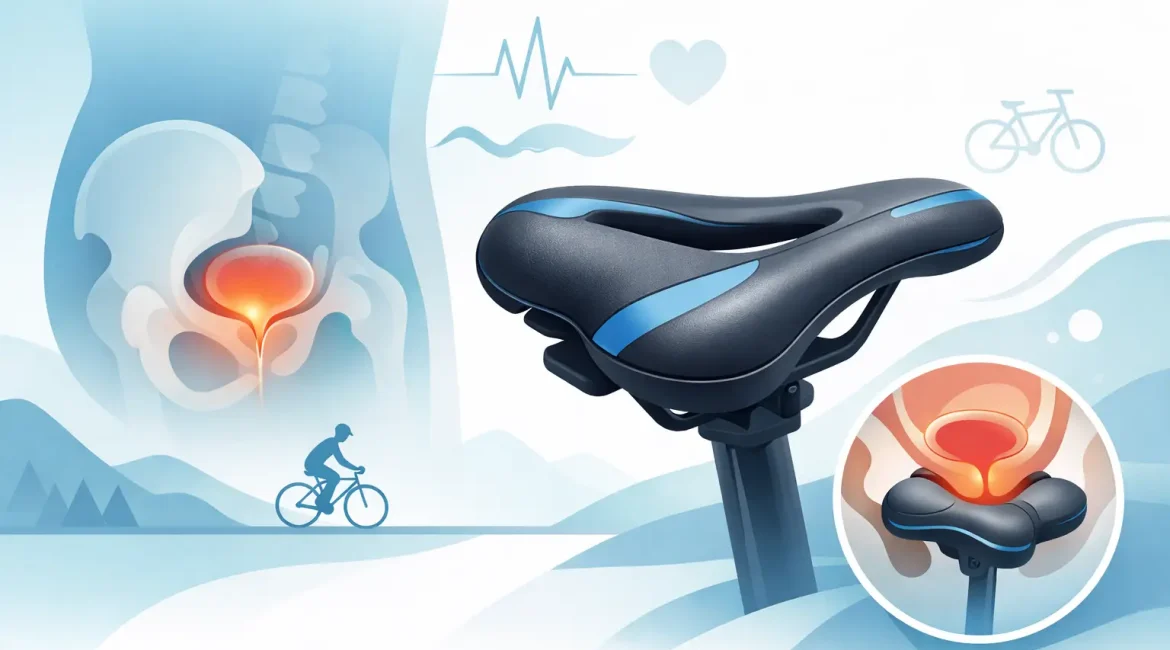
If your saddle leaves you shifting every few minutes, standing to relieve numbness, or finishing a ride with deep perineal soreness, the problem is not your tolerance. It is very often the saddle. Finding the best bike seat for prostate comfort means looking past familiar shapes and asking a more useful question – where is your body weight actually going when you ride?
For many cyclists, especially men riding long distances or returning to cycling later in life, the answer is uncomfortable. Traditional saddles tend to load soft tissue in the centre of the pelvis rather than supporting the sit bones properly. That pressure can irritate the perineum, aggravate prostate discomfort, create friction and leave you with numbness that no serious rider should treat as normal.
What makes a bike seat prostate-friendly?
A prostate-friendly saddle is not just a softer saddle. Softness alone often makes the problem worse because the body sinks into the padding and increases compression around sensitive tissue. The real goal is pressure management. A good design shifts support outward, onto the bony structures that can carry load, while reducing contact in the centre where nerves, blood vessels and soft tissue are more vulnerable.
That is why the best bike seat for prostate comfort usually has a clear anatomical strategy. It may use a central relief channel, a deep cut-out, a lowered nose, split support zones, or a combination of these. The common thread is simple: less pressure where pressure should never have been concentrated in the first place.
This matters even more on endurance rides. A saddle that feels passable for thirty minutes can become a serious problem after two hours, because pressure, heat and repeated movement build on each other. Friction rises. Blood flow drops. Hot spots become pain points. Riders often assume they need tougher skin or thicker shorts. In reality, they often need a saddle designed around pelvic anatomy rather than old racing conventions.
Why standard saddles fail so many riders
Most standard saddles are still built around narrow, elongated shapes with a pronounced nose and a central area that stays too involved in load-bearing. That layout may look normal, but normal is not the same as healthy. If the nose sits high and the centre section remains active under the pelvis, the perineum takes more pressure than it should.
Cut-out saddles tried to solve this, and some do help. But many simply remove a strip from the middle while keeping the same basic pressure pattern around it. The edges of the cut-out can create new hot spots. A heavily padded model can also mask the issue at first, then compress under body weight and force tissue into the relief zone. That is why riders sometimes say a saddle felt great in the garage and terrible on the road.
Noseless saddles address centre pressure more aggressively, but they can create compromises in control, pedalling stability and overall bike handling. For some riders, especially those doing steady recreational mileage, that trade-off is acceptable. For road cyclists, triathletes and experienced riders who still want positional stability and efficient power transfer, a better answer is often an anatomical saddle that reduces central pressure without abandoning saddle control altogether.
Best bike seat for prostate comfort – what to look for
The right shape matters more than branding, and the details matter more than marketing photos. Start with width. A saddle that is too narrow forces support inward, away from the sit bones and into the perineum. A saddle that matches your sit-bone width gives your skeleton somewhere to rest. This is one of the most overlooked factors in cycling comfort.
Next is the nose profile. A lower nose can make a major difference because it reduces upward pressure into the front of the pelvis during a forward riding position. This is especially relevant for riders on drop bars, triathlon bikes, or anyone who rotates the pelvis to stay aerodynamic. A high, conventional nose often becomes the main source of soft-tissue loading.
The support zones should also be considered. Separated or angled seat pads can help guide weight onto the left and right sit-bone regions rather than allowing the centreline to become a pressure point. This is a more precise solution than simply adding more foam. High-rebound foam, when used properly, helps because it supports without collapsing. Cheap, overly soft padding tends to bottom out and create instability.
Finally, think about friction as well as pressure. Prostate comfort is not just about what happens when you sit still. It is also about what happens over thousands of pedal strokes. If the saddle shape causes rubbing at the inner thigh or repeated micro-movement around the perineum, discomfort accumulates even when pressure readings look acceptable on paper.
The difference between comfort and anatomical support
Many riders shop for comfort and end up buying cushioning. Those are not the same thing. Real comfort on a bicycle comes from support, stability and pressure relief in the right places. A sofa-soft saddle may feel reassuring in your hand, but your body does not ride in your hand. Under pedalling load, excess softness can increase torsion, friction and tissue compression.
Anatomical support feels different. It can seem unusual at first because the load pattern changes. You may feel more contact under the sit bones and less in the middle. That is the point. A well-designed saddle should not ask your soft tissue to do the work your pelvic structure is meant to do.
This is where purpose-built ergonomic designs stand apart. Saddles engineered around a low nose, separated pads and dimensions based on sit-bone research can reduce perineal pressure far more effectively than standard shapes with a cosmetic cut-out. That design philosophy is exactly why products such as the Aeroelastic AE Saddle appeal to riders who have already tried mainstream options and are tired of managing symptoms instead of solving the cause.
Bike fit still matters, but it cannot fix a bad saddle
A poor bike fit can absolutely increase saddle pressure. If your bars are too low, your saddle is tilted badly, or your reach is too long, you may rotate forward excessively and load the front of the saddle. Small fit changes can help. A slight adjustment in saddle tilt, saddle height or fore-aft position can sometimes reduce pressure significantly.
But fit is not a miracle cure. A badly shaped saddle remains a badly shaped saddle, even when the bike is adjusted around it. Riders often spend months tweaking millimetres because they are trying to compensate for a design that never supported them properly to begin with. If you have persistent numbness, burning, chafing or prostate-area discomfort, do not assume the answer is endless experimentation with position alone.
The better approach is to pair a sound bike fit with a saddle designed to protect soft tissue. That gives you a stable platform first, then fine-tuning second.
Who needs the best bike seat for prostate comfort most?
Any cyclist can benefit from lower perineal pressure, but some riders have less margin for error. Men with an enlarged prostate, a history of pelvic discomfort, post-procedure sensitivity or recurring numbness should be especially cautious about conventional saddles. The same goes for endurance cyclists spending several hours at a time in one position.
Older riders often notice the issue more clearly, not because cycling suddenly became harsher, but because tolerance for chronic pressure changes with age and tissue resilience is not endless. Serious recreational cyclists and former racers also tend to recognise the warning signs earlier. They know the difference between normal adaptation and a contact point that is fundamentally wrong.
Women should not ignore this conversation either. Although the anatomy differs, the principle is the same: a saddle that overloads soft tissue and creates friction is not an acceptable long-term solution. A genuinely anatomical saddle benefits any rider who wants stable support without central pressure.
How to judge whether a saddle is actually working
A good saddle does not need weeks of suffering to prove itself. There may be a short adaptation period if the support pattern is new, but clear warning signs should not be dismissed. Ongoing numbness, sharp pressure, tingling, saddle sores and the constant urge to shift position are not part of a successful break-in.
What you want instead is stable support under the sit bones, reduced need to stand up for relief, and less awareness of the saddle during steady riding. On longer rides, the difference becomes even clearer. The right saddle preserves comfort deeper into the session rather than asking you to manage deterioration.
If you finish a ride with no numbness, less friction and no lingering prostate-area irritation, that is not a luxury feature. It is evidence that the saddle is finally doing its job.
Cyclists are often willing to spend heavily on wheels, drivetrains and data, then tolerate the one contact point that can genuinely undermine both health and performance. That makes little sense. Protecting your prostate and perineal health is not a niche concern for cautious riders. It is a practical requirement for anyone who wants to keep riding strongly, comfortably and for years to come.
The best saddle is the one that lets your body forget it is defending itself, so your legs can simply get on with the ride.
