
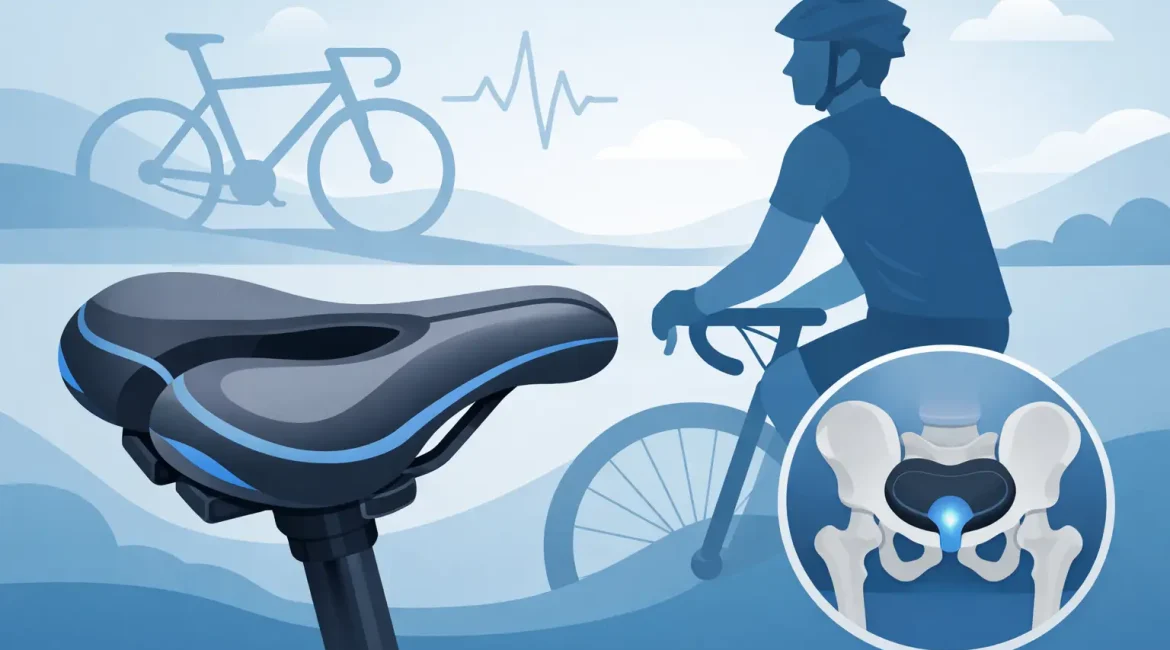
A ride that should build fitness can quietly do the opposite when the saddle loads the wrong tissue for hour after hour. If you are searching for a prostate friendly cycling seat, you are probably not chasing marginal gains. You are trying to stop numbness, burning, chafing, deep pelvic ache, or the dull pressure that makes long rides feel like damage control.
That problem is real, and it is more common than the cycling industry likes to admit. Traditional saddles were normalised around shape conventions, not around what happens to soft tissue, nerves and blood flow when a rider spends serious time in a forward-leaning position. For many cyclists, especially men dealing with prostate sensitivity or perineal discomfort, the standard approach simply asks the body to tolerate too much.
What makes a prostate friendly cycling seat different
A genuinely prostate friendly cycling seat is designed to move load away from the perineum and onto the sit bones, where the body is better equipped to carry weight. That sounds obvious, but many saddles still fail at this because they combine a narrow support area, an intrusive nose and foam that compresses in all the wrong places.
The result is familiar. Pressure builds through the centreline. Blood flow can be restricted. Nerves become irritated. Friction increases as the rider shifts to escape discomfort. On a short spin, you may ignore it. On a long road ride, turbo session or sportive, the body keeps score.
A better saddle does not just add more padding. More foam can actually make things worse if it collapses around the soft tissue and increases contact where you need relief. The real goal is anatomical load management. The saddle should support bone, not crush the structures between it.
Why standard saddles often create prostate pressure
Cyclists tend to blame fit, shorts or riding position first, and those factors do matter. But saddle architecture is often the main culprit. A conventional nose can act like a wedge between the thighs and into the perineal area, particularly when the pelvis rotates forward in an aggressive riding posture.
Cut-out saddles try to fix this by removing material from the middle, and some do help. The problem is that a cut-out alone does not guarantee lower pressure. If the shape around the cut-out is still too narrow, too tall, or badly contoured for your pelvic position, the remaining edges can create concentrated pressure instead of relief.
Noseless saddles address centre pressure more aggressively, but they can introduce stability issues for riders who need control during longer, faster efforts. That is why the best ergonomic designs tend to focus on a balance of pressure relief, support and pedalling stability rather than one dramatic feature.
The design features that matter most
If you want pain-free riding, the details matter. A prostate friendly cycling seat should first reduce intrusion at the front. A lower saddle nose helps minimise contact with the perineal region while still giving the rider positional control. This is especially important for endurance cyclists who spend long periods seated and cannot afford constant tissue irritation.
The second priority is independent support under the sit bones. Separated and angled seat pads can be far more effective than one continuous platform because they let each side support the pelvis without forcing pressure into the centre. This matters when the pelvis moves slightly with each pedal stroke and when the rider shifts between relaxed and more aggressive positions.
Foam choice matters too. Very soft foam feels reassuring in the hand and often disappointing on the road. It bottoms out, increases heat and allows more rubbing. High-rebound polyurethane foam behaves differently. It cushions without collapsing too quickly, which helps maintain support over time rather than letting the body sink into pressure.
Then there is width. This is where many riders go wrong. A saddle that is too narrow pushes load inward towards soft tissue. A saddle that is too wide can interfere with pedalling and create inner-thigh friction. The right width should reflect sit-bone spacing and riding posture, not marketing labels such as race, comfort or endurance.
Prostate friendly cycling seat fit is not just about comfort
Cyclists sometimes treat saddle discomfort as an annoyance rather than a warning sign. That is a mistake. Persistent numbness, tingling, genital discomfort and pelvic pain are signals that pressure distribution is poor. If those symptoms keep appearing, the issue is not toughness. It is biomechanics.
A prostate friendly cycling seat should protect function as well as comfort. Lower perineal pressure can help preserve blood flow and reduce the repeated compression that contributes to numbness and soft-tissue irritation. For riders with prostate enlargement, a history of pelvic pain, or increased sensitivity with age, that is not a luxury feature. It is a serious equipment choice.
This is why a science-led saddle design matters more than a fashionable silhouette. The best designs are built around anatomy first, with each shape decision serving a clear mechanical purpose. That includes how the nose transitions, how the rear support is angled, and how the padding behaves once body weight and pedalling forces are applied.
How to tell if your current saddle is the problem
Many riders adapt gradually to a bad saddle and stop recognising the pattern. If discomfort always builds after forty minutes, if you stand more often than you need to, if you constantly shift on the saddle to escape pressure, or if post-ride numbness has become normal, your saddle is not doing its job.
Watch for friction as well as pressure. Chafing at the inner thigh, hot spots near the perineum and soreness that lingers into the next day often indicate that the saddle shape is forcing movement where there should be stable support. Zero friction may sound ambitious, but it is a valid engineering target. Less rubbing means less inflammation, less compensation and a better chance of staying comfortable deep into a long ride.
Another clue is when fit adjustments only partly help. You can tilt the saddle, move it back a few millimetres or change bar height, but if the core shape still loads the wrong tissue, the relief will be limited. A poor saddle can make a good bike fit feel bad.
What to look for before you buy
Ignore the old assumption that a firmer, slimmer saddle is automatically faster. If it causes pressure, it costs you stability, focus and endurance. The better question is whether the saddle supports your actual anatomy in your actual riding position.
Look for a design that clearly addresses perineal unloading rather than merely promising comfort in broad terms. Lower nose profiles, separated support zones and dimensions based on sit-bone width research are far more meaningful than generic claims about extra cushioning.
It also helps to be realistic about adaptation. An anatomical saddle can feel different at first because it is changing where load is carried. Different is not bad. The key is whether pressure on soft tissue reduces and whether support under the sit bones feels more stable over several rides.
Aeroelastic built its AE Saddle around exactly that principle. Rather than treating prostate discomfort as an unavoidable side effect of cycling, the design addresses the underlying mechanics with a low nose, separated angled pads and resilient foam intended for long-distance pressure relief.
The trade-offs riders should understand
There is no single saddle that suits every body, every bike and every discipline equally. An endurance road rider with a moderate pelvic rotation may need something different from a time trial rider in a very aggressive position. A wider saddle can improve support but may feel intrusive if the rider’s pedalling mechanics are tight. A more radical pressure-relief shape can solve numbness but require a short adjustment period for bike handling confidence.
That does not mean saddle choice is guesswork. It means the right solution is specific. The best prostate friendly cycling seat is the one that reduces centre pressure without compromising pedalling stability or introducing new friction points. If a saddle only solves one problem by creating another, it is not the answer.
Why long-distance riders notice the difference first
Short rides can hide saddle flaws. Longer rides expose them quickly. The longer you stay seated, the more repeated compression, heat and friction accumulate. This is why endurance cyclists, sportive riders and experienced recreational cyclists are often the first to seek out a more anatomical saddle. They have enough saddle time to recognise the pattern and enough body awareness to know when comfort has turned into tissue stress.
A properly engineered saddle can change more than comfort. It can improve how consistently you hold position, how relaxed your upper body stays and how willing you are to remain seated over distance. When pain drops, efficiency often improves as a side effect.
Choosing a better saddle is not an indulgence or a sign that you have become soft. It is a practical decision to protect your prostate, reduce unnecessary pressure and keep riding stronger for longer. Your body should not have to absorb a design failure every time you clip in.
