
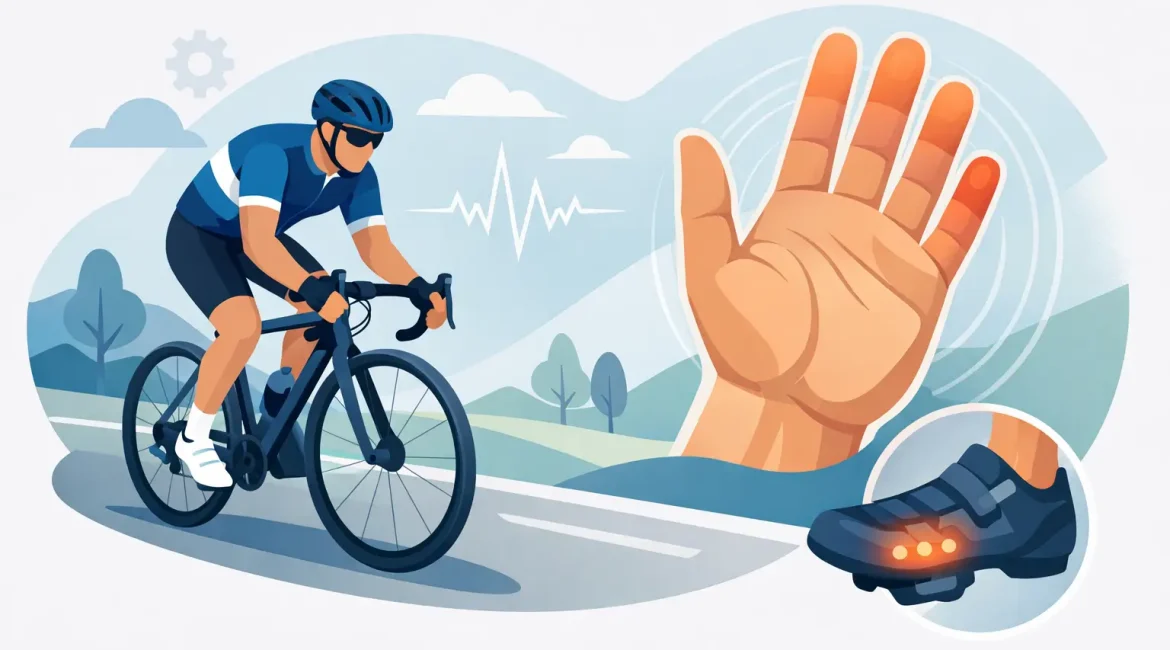
You know the feeling. An hour into a ride, power is fine, breathing is steady, but the contact points start sending a different message – tingling, deadness, pressure, then numbness. If you are wondering how to reduce numbness when cycling, the answer is rarely one small adjustment. Most of the time, it is a pressure-management problem caused by the interaction between saddle shape, bike fit, pelvic position, riding posture and ride duration.
Numbness is not something to normalise. In the perineal area, it usually means soft tissue is taking load that should be supported by the sit bones. In the hands, it often points to too much weight through the bars or poor wrist position. Either way, the body is telling you that compression is outpacing circulation and nerve comfort. For endurance riders, that is not just a comfort issue. It is a performance and health issue.
Why numbness happens on the bike
Cycling puts the body in a sustained, fixed position. That is efficient for speed, but not always forgiving for anatomy. When your saddle is too narrow, too high at the nose, too soft in the wrong places, or shaped around convention rather than pelvic support, pressure migrates into the perineum instead of staying on the ischial tuberosities – your sit bones.
That matters because the perineal region contains nerves, blood vessels and sensitive soft tissue. Long periods of compression can lead to tingling, numbness, chafing and, for some riders, prostate irritation or pelvic discomfort. A cut-out can help in some cases, but it is not automatically a solution. If the surrounding structure still collapses inward or the nose still drives upward into soft tissue, pressure remains.
The same principle applies elsewhere. Hand numbness is usually a load-distribution problem. If the front end is too low, the reach too long, or the saddle angle pushes you forward, your hands become stabilisers instead of light contact points.
How to reduce numbness when cycling at the source
The most effective place to start is the saddle, because that is where prolonged pressure usually begins. A good saddle does not simply feel soft in the car park. It supports the skeletal structure of the pelvis under pedalling load.
Start with saddle shape, not just padding
Many riders assume extra cushioning will solve numbness. In practice, excessive softness often makes things worse. You sink into the foam, the tissue deforms around pressure points, and circulation can be restricted more, not less.
A better approach is anatomical support. That means a saddle wide enough for your sit-bone spacing, shaped to reduce contact with the perineum, and stable enough that you are not constantly shifting to escape friction. A lower nose can be especially important for riders dealing with genital numbness, prostate pressure or recurring chafing. If the nose stays high, it can continue to load tissue even when the rear of the saddle looks supportive.
Separated and angled rear pads can also make a real difference because they support the pelvic bones more directly while leaving the central area less compressed. This is one reason why standard one-piece saddles often fail riders on longer efforts. They ask soft tissue to tolerate load it was never meant to carry for hours at a time.
Check saddle width against your anatomy
Saddle width is not a style preference. It is a biomechanical variable. If the saddle is too narrow, the sit bones miss the support platform and pressure shifts inward. If it is too wide, you may get inner-thigh interference and unstable pedalling.
For many riders, especially those doing long road miles or indoor sessions, width is one of the most overlooked causes of numbness. A saddle chosen around actual sit-bone support rather than racing aesthetics usually gives a more immediate improvement than changing shorts or bar tape.
Get the saddle angle right
Even a well-designed saddle can become problematic when tilted badly. A nose-up angle commonly increases perineal pressure. A nose-down angle can reduce that pressure, but go too far and you slide forward, overloading the hands, shoulders and knees.
The key is small changes. Work in tiny increments and test them under real riding conditions, not just on the turbo for five minutes. Often, a subtle adjustment is enough to reduce soft-tissue compression without destabilising the rest of your position.
Bike fit still matters
If you want to know how to reduce numbness when cycling for good, do not treat the saddle in isolation. The whole bike fit influences where pressure ends up.
Reach and bar drop affect pelvic pressure
A very aggressive front end rotates the pelvis forward. That can be fast, but it can also increase contact on soft tissue if the saddle does not match that posture. Riders with limited hip mobility are particularly vulnerable here. They try to hold an aerodynamic position, the lower back rounds, the pelvis rolls, and the pressure moves straight into the perineum.
Sometimes the fix is not dramatic. A slightly shorter reach, a modestly higher bar position, or a different hood angle can reduce the need to brace through the hands and rotate too far onto the front of the saddle.
Saddle height can create numbness too
A saddle that is too high causes rocking at the hips. That adds friction and instability, which often leads to repeated pressure and micro-trauma in the same area. Too low, and the rider may sit heavily with less efficient leg extension and more constant loading.
This is why numbness often appears alongside chafing. Both are signs that support and motion are not working together properly.
Clothing and contact points are part of the system
Good shorts help, but they cannot rescue a poor saddle. Chamois thickness, seam placement and fabric tension all affect comfort, yet they are secondary to pressure distribution.
If your shorts bunch, the pad is too bulky for your saddle shape, or the fabric creates heat and drag in the groin, numbness can appear sooner. Clean shorts, proper sizing and a pad that works with your position are basic but worthwhile checks. Chamois cream can reduce friction, though it will not solve nerve or vascular compression caused by poor support.
Gloves and bar tape can help with hand numbness, but again, they are not the primary fix if your fit is pushing too much mass forwards.
Movement reduces sustained compression
Even with the right equipment, static pressure over time is still pressure. Endurance riders benefit from small posture changes during the ride. Standing briefly on climbs, shifting hand positions and resetting pelvic posture every few minutes can restore circulation before numbness sets in.
This is especially useful indoors, where there is less natural movement than on the road. Turbo sessions can expose saddle problems faster because the bike is more fixed and the rider changes position less often.
If numbness appears at the same time point on every ride, pay attention to that pattern. It often reveals a threshold problem: the setup is tolerable for short durations but fails under sustained load.
When the problem is the saddle design itself
Some riders spend months adjusting fit when the real issue is simpler: the saddle was never designed around anatomy in the first place. Traditional saddles often prioritise convention, silhouette or racing habit over perineal relief. That is why many experienced cyclists have tried multiple models, cut-outs and padding options without solving the problem.
A true pressure-relieving saddle should reduce central compression, lower the chance of crotch friction and support the rider on the structures meant to bear weight. For cyclists dealing with prostate sensitivity, pelvic discomfort or recurring numbness, this is not a luxury feature. It is the baseline requirement for riding pain-free.
This is exactly the space Aeroelastic was built to address – not with generic comfort claims, but with a design focused on low nose height, separated support zones and sit-bone-led dimensions.
When to take numbness seriously
Occasional mild tingling after a long ride is one thing. Persistent numbness, recurring genital deadness, burning, sharp pain or symptoms that continue off the bike deserve more attention. If adjustments do not improve things, speak to a qualified bike fitter or medical professional, especially if you have prostate concerns, pelvic floor symptoms or neurological issues.
Cycling should not require you to ignore warning signs. Numbness is useful feedback. It tells you that load is going to the wrong place, for too long, in a way your body does not tolerate well.
A practical way to test changes
Change one variable at a time. Start with the saddle shape and width, then angle, then position, then cockpit adjustments. Test each change on the kind of ride that usually triggers symptoms. If you alter everything at once, you will not know what actually solved the problem.
And be honest about adaptation. A new saddle can feel different before it feels better, but numbness is not a break-in issue you should push through for weeks. Pressure relief should be noticeable, not theoretical.
The goal is not to become more tolerant of numbness. The goal is to remove the cause, protect circulation and nerve function, and let your contact points disappear into the background so you can ride as long as your legs and lungs allow.

Hello:
I love my Aeroelastic AE saddle!
I’m 72 and very fit. In my 40s, I was a competitive road cyclist (without distinction). Sparing you the details …due to “side effects” from prostate surgery in 2001, I had 4 subsequent surgeries that involved the implantation of medical devices in the groin and scrotum area. Due to these devices, I was not able to ride any available bicycle saddle since 2001.
I tried every known saddle, recumbent bikes (hated) and elliptical stand-up bikes (scary dangerous on wet roads).
Recently, I discovered your “weird” Aeroelastic AE saddle. Your amazing saddle got me back on a regular road bike after 25+ years of no riding. In fact, I rode 1600+ miles in the first 5 months on this saddle with zero issues.
Your saddle is comfortable (after acclimation) and 100% effective in eliminating pressure on the perineum area. It may not be for everyone. Some people might not be able to adapt to it, but I love it. Fact: without this saddle I could not ride at all!
My one complaint: your Aeroelastic AE saddle is VERY heavy!
Question: Would you consider a collaboration with me to make a lighter version incorporating carbon fiber and titanium? If so, I would be VERY interested.
Thanks in advance.
Randall Washington (Randakk)