
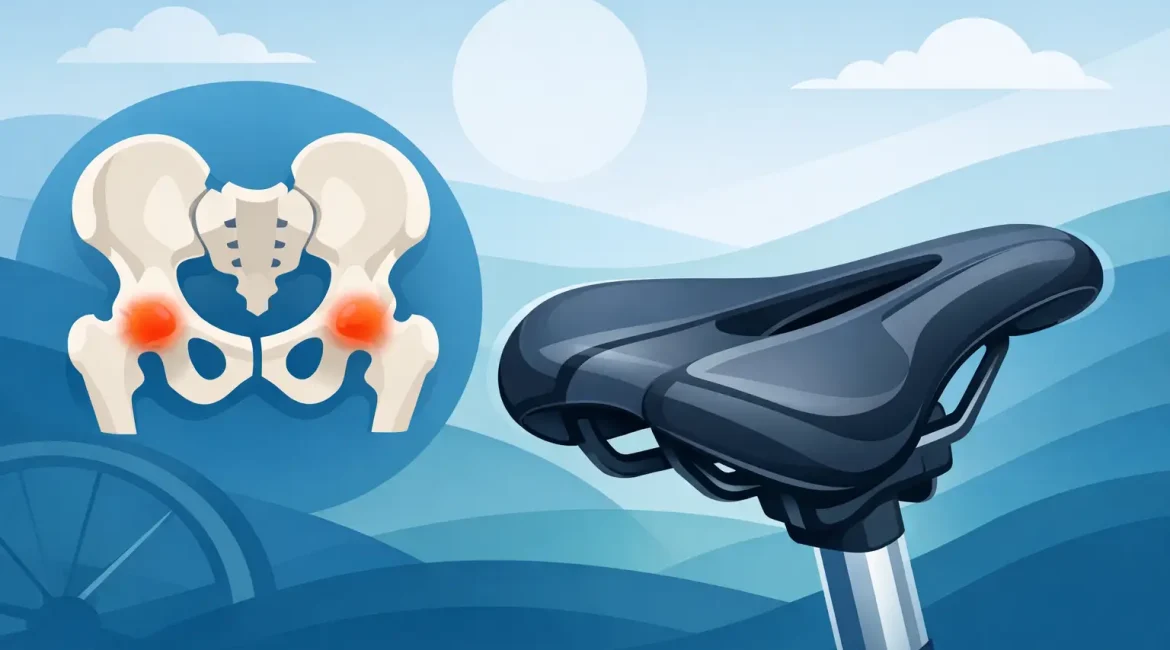
A saddle can feel fine for 30 minutes and still be completely wrong for your anatomy. That is why the search for the best saddle for sit bone support matters so much. If your body weight is not being carried by the ischial tuberosities – your sit bones – it usually ends up somewhere it should not: the perineum, soft tissue, nerves, or prostate region.
For serious riders, that is not a minor comfort issue. It is a performance problem, a health problem, and often the reason long rides become something to endure rather than enjoy. Numbness, chafing, burning pressure, and the constant need to shift position are all signs that the saddle is failing to support the skeleton properly.
What the best saddle for sit bone support actually does
A good saddle does not simply feel soft in the shop or look sporty on the bike. It supports the pelvis in a stable position so your weight is carried by bone, not compressed into soft tissue. That sounds obvious, yet many conventional saddles still rely on a long, narrow shape that places too much load through the centreline.
True sit bone support comes from a combination of width, pad placement, shape, and pressure relief. Width matters because sit bones need a platform they can actually rest on. Pad placement matters because the support points must align with the rider’s anatomy, not with a generic mould. Shape matters because a saddle that looks wide enough can still tilt your pelvis into the wrong position if the nose is too high or the rear profile is poorly angled.
The result should be simple: stable support under the rear of the pelvis, lower pressure through the middle, and less friction where riders usually suffer most.
Why many saddles get sit bone support wrong
The cycling industry has spent decades refining saddles around tradition as much as anatomy. Many models are still built around a narrow nose and a central riding position that assumes soft tissue will tolerate some pressure as normal. It is not normal. It is just common.
Cut-out saddles improved things for some riders, but they do not always solve the root problem. If the saddle remains too narrow, too peaked, or too aggressive in profile, the cut-out can become a partial fix rather than a real solution. Some riders even experience pressure concentrated around the edges of the cut-out, especially on longer rides.
Extra padding is another common trap. A heavily padded saddle may feel forgiving at first, but if the foam collapses under load, the pelvis loses support and the rider sinks into the middle. That can increase perineal pressure rather than reduce it. Soft is not the same as supportive.
How to judge sit bone support without guessing
If you want the best saddle for sit bone support, start by ignoring labels like race, endurance, comfort, or gel. Those categories tell you very little about how the saddle will carry your body.
The first question is whether the usable support area matches your sit bone width in your real riding posture. Sit bone distance changes in practical terms depending on how upright or rotated your pelvis is on the bike. A road rider in a lower position does not use a saddle in the same way as someone on a hybrid commuting upright. That is why a saddle that suits one discipline can fail badly in another.
The second question is whether the support zones are actually where your body needs them. On a properly engineered saddle, the pads should meet the bony contact points cleanly and predictably. You should feel held up, not pinched, not tipped forward, and not forced to hover on soft tissue.
The third question is stability under pedalling load. If the saddle causes constant side-to-side shifting, rubbing at the inner thigh, or a need to perch on one side, the support geometry is wrong even if the width appears correct.
Features that matter most in the best saddle for sit bone support
A wider rear platform is usually essential, but width alone is not enough. The shape of the rear section must allow the sit bones to settle onto distinct support zones rather than slide towards the centre. This is especially important for endurance cyclists who spend hours repeating the same pedal stroke.
A lowered nose can make a major difference. Traditional noses often create unnecessary contact and upward pressure in the perineal region, particularly when the rider rotates forward. Lowering that nose reduces contact where cyclists are most vulnerable to numbness and prostate irritation.
Separated or independently angled seat pads can also improve support. Instead of forcing both sides of the pelvis onto one continuous curved surface, a split-pad design can support each sit bone more directly. That approach can reduce centre pressure while improving pelvic control.
Foam choice matters too. High-rebound polyurethane foam tends to perform better than cheap, overly soft padding because it resists bottoming out. The goal is not a sofa. The goal is controlled support that remains consistent after an hour, three hours, or an all-day ride.
Sit bone support and prostate health are closely linked
For many male cyclists, especially middle-aged and older riders, saddle discomfort is not just about soreness. It is about protecting vulnerable anatomy over time. If a saddle fails to support the sit bones properly, pressure often migrates forwards into the perineum. That can contribute to numbness, irritation, and unnecessary compression near the prostate region.
This is where anatomical design stops being a comfort upgrade and becomes a health decision. A saddle that keeps body weight on the skeletal structures and off the soft tissue is not a luxury. It is a better mechanical solution to a very real physiological problem.
Female riders benefit from this principle as well. Although the anatomical details differ, the same rule applies: if bone is not carrying the load, soft tissue usually pays the price. Better sit bone support means less friction, less swelling, and more stable comfort across longer distances.
The trade-offs riders should understand
There is no universal saddle that suits every pelvis, every bike fit, and every discipline. A very wide saddle may support the sit bones well for a more upright rider but cause thigh interference in an aggressive road position. A very firm saddle may feel superb on long rides once adapted to, yet feel unforgiving in the first few outings.
There is also an adjustment period with any saddle that changes pelvic mechanics significantly. If you move from a conventional narrow saddle to a more anatomical design with lower nose pressure, the difference can feel unusual before it feels obviously better. That does not mean the saddle is wrong. It means your body is no longer compensating for the old pressure pattern in the same way.
Bike fit still matters. Even the best saddle cannot fully compensate for bars that are too low, a saddle tilted badly, or a reach that drags the pelvis forwards. A better saddle solves the contact problem, but the whole riding position still needs to make sense.
What a better design looks like in practice
The most effective saddles for sit bone support tend to reject the old assumption that one continuous shell with a raised nose is the default answer. Instead, they focus on pressure mapping, anatomical separation, and controlled pelvic support.
That is why science-backed saddles built around sit bone width research stand apart from standard designs. Rather than asking the rider to adapt to the saddle, they adapt the support structure to the rider’s load points. A low nose, separated seat pads, and resilient foam can work together to reduce crotch friction, unload the perineum, and keep the rider supported where support actually belongs.
This is the thinking behind Aeroelastic’s approach. It is not styling for the sake of difference. It is a direct response to the failure of traditional saddles to solve pressure distribution properly.
How to tell when you have found the right saddle
The right saddle usually reveals itself through what stops happening. You stop standing up every few minutes to relieve pressure. You stop finishing rides with numbness. You stop shifting around to find a safe place to sit. You stop thinking about the saddle at all, which is exactly what good ergonomic design should achieve.
On longer rides, you should feel supported at the rear of the pelvis with minimal centreline pressure. Your pedalling should feel stable rather than constrained. Friction should reduce, not build with time. If your sit bones feel loaded but the surrounding tissue feels calmer, that is a strong sign the saddle is doing its job.
Choosing the best saddle for sit bone support is less about chasing a famous model and more about insisting on correct load distribution. Your body weight belongs on bone. Once the saddle respects that basic truth, long-distance comfort stops being guesswork and starts becoming repeatable.
