
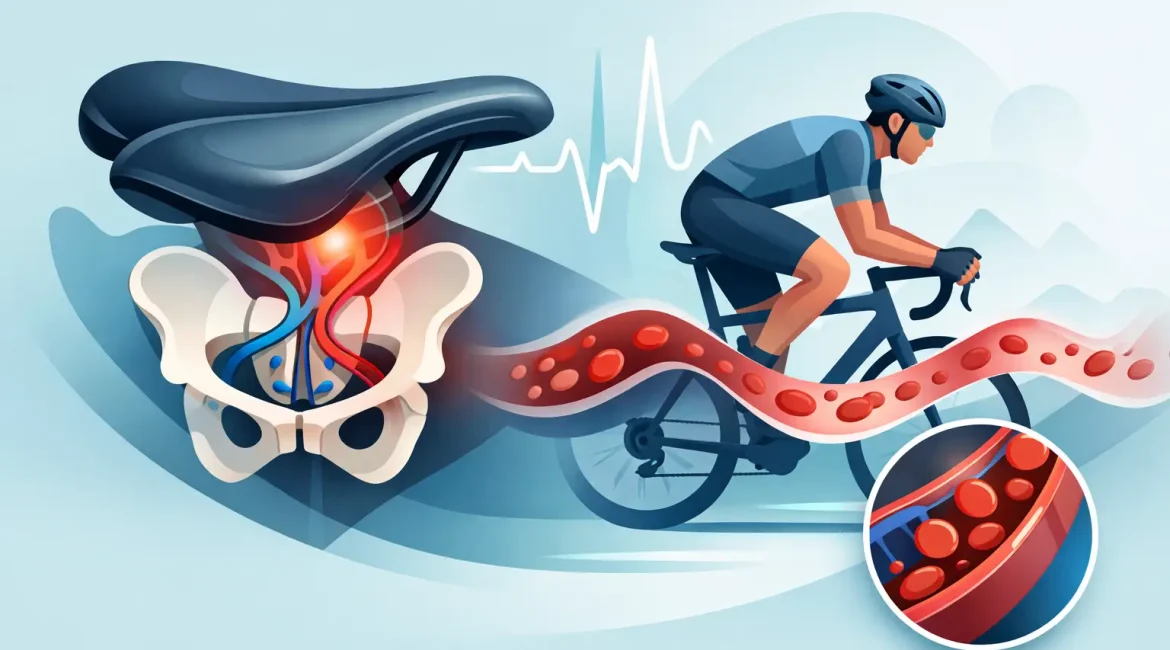
A rider can ignore mild numbness for a few miles. Ignore it for a season and it stops being a comfort issue and starts looking like a design failure. Cycling saddle blood flow is not a fringe topic for overly sensitive riders. It sits at the centre of long-ride comfort, pelvic health and sustainable performance.
If your saddle compresses soft tissue, it can reduce circulation through the perineal area, increase nerve irritation and create the familiar pattern of tingling, burning, numbness or deep ache. Many cyclists treat that as normal because traditional saddles have trained them to. It is not normal. It is common, and those are not the same thing.
Why cycling saddle blood flow gets compromised
The problem starts with anatomy and load distribution. When you sit on a bike, your bodyweight should be supported primarily by the ischial tuberosities – your sit bones. Those structures are built to take pressure. The perineum is not. It contains blood vessels, nerves and sensitive soft tissue that do not respond well to sustained compression.
A conventional saddle often narrows aggressively towards the nose and asks the rider to tolerate pressure where there should be relief. On shorter rides, that may produce little more than discomfort. On longer rides, especially in an aerodynamic position, the pelvis rotates forwards and the contact point shifts. Pressure moves away from bony support and into tissue that can restrict circulation.
That is why riders often report symptoms that build gradually rather than appearing at once. Blood flow is not simply on or off. It can be reduced enough to create numbness and friction long before a rider feels sharp pain. By the time the pain arrives, the saddle has usually been loading the wrong area for quite some time.
The real-world signs of poor saddle blood flow
Most riders notice the obvious symptoms first. Numbness after an hour. Pins and needles when standing out of the saddle. Heat, chafing or swelling after a longer session. For some men, there is also concern around prostate pressure, pelvic discomfort or changes in sensation after repeated rides.
Women experience the same underlying issue through a different anatomy, but the principle is identical. If a saddle concentrates pressure into soft tissue rather than supporting the pelvis correctly, circulation suffers and friction increases. The result may be numbness, labial pressure, chafing or a persistent sense that the rider is always shifting around trying to escape the contact point.
That constant repositioning matters. It wastes energy, interrupts cadence and makes it harder to stay stable in an efficient riding position. So this is not only about health. It is also about preserving performance over distance.
What actually improves cycling saddle blood flow
Relief channels and cut-outs get most of the attention, but they are only part of the story. A hole in the middle does not solve much if the rest of the saddle still pushes tissue inward or leaves the rider perched on unstable edges. Good blood flow comes from reducing compression overall, not just removing a strip of material.
The first requirement is proper sit-bone support. The saddle has to be wide enough, in the right zone, to hold the pelvis on bony structures instead of allowing it to collapse into the centre. Too narrow and the rider sinks onto soft tissue. Too wide and the inner thigh can rub, especially under power. There is no universal width that suits everyone, which is why generic saddle shapes so often miss the mark.
The second requirement is nose design. A high, narrow, traditional nose may help with control in certain riding contexts, but it is often where pressure builds when the rider rotates forwards. Lowering the nose profile and changing the way the front of the saddle interacts with the body can dramatically reduce perineal compression without making the bike feel unstable.
The third requirement is separated support rather than a single continuous platform. When the two contact zones are angled and positioned to follow pelvic anatomy, the saddle stops acting like a clamp on the centreline of the body. That is where many standard designs fail. They assume symmetry and flat loading where the body actually needs relief and contour.
Foam also matters, but not in the way many riders think. More padding is not automatically better. Very soft foam can increase pressure by allowing the rider to sink deeper into the saddle, which creates more tissue deformation and more friction. High-rebound foam that supports rather than swallows the rider tends to work better for circulation over longer distances.
Why bike position changes the pressure picture
A decent saddle cannot fully compensate for a poor bike fit. Saddle height, tilt and fore-aft position all affect how load reaches the pelvis. If the saddle is too high, the hips may rock and create repeated rubbing. If it is too far forward, the rider can end up carrying more weight through the front of the saddle. If the nose is tilted too far up, pressure often concentrates exactly where it should not.
The aerodynamic position deserves special attention. Road racers, triathletes and fast endurance riders usually rotate the pelvis forwards to reach a lower torso angle. That movement changes the shape of the contact area. A saddle that feels acceptable on an upright commuter bike may become a blood-flow problem once the rider drops into the hoods or aerobars.
This is why quick car park tests are misleading. A saddle should be judged after a proper fit and under realistic riding conditions. Ten minutes spinning around the block tells you almost nothing about circulation after two hours at tempo.
The trade-off riders often get wrong
Cyclists are frequently told to adapt to the saddle. Sometimes that is fair. New contact points can take a few rides to settle. But there is a difference between adaptation and repeated tissue insult.
A firmer, anatomically correct saddle can feel unusual at first because it shifts support onto the sit bones, where it belongs. That can be a positive adjustment period. Ongoing numbness is not. Recurrent tingling, persistent chafing and post-ride pelvic discomfort are not signs that your body needs to toughen up. They are signs that the interface is wrong.
Cut-out saddles can help some riders, especially when they are paired with the right width and shape. For others, the edges of the cut-out become new pressure points. Noseless saddles reduce front-end compression but can feel compromised in control or pedalling stability if the design does not properly manage support. There is always a balance between pressure relief, bike handling and pedalling mechanics. The goal is not novelty. The goal is effective anatomical support.
What to look for in a blood-flow-friendly saddle
Start by asking one blunt question: where is your weight actually going? If the answer is soft tissue, the saddle is wrong for you regardless of what the marketing says.
Look for a design built around sit-bone loading, front-end pressure relief and low-friction contact points. Saddles with separated seat pads and a lower nose profile tend to address the problem more directly than conventional shapes that rely on a central cut-out alone. Dimensions should be informed by pelvic support, not by racing tradition.
Material choice matters too. You want enough compliance to absorb vibration, but not so much that the saddle deforms under load and pushes tissue into stressed positions. Shape is the first job. Foam is the finishing detail.
For riders dealing with prostate sensitivity, recurring numbness or long-distance discomfort, this is not an area to compromise. The best saddle is not the one that looks fastest in the workshop. It is the one that lets you hold power, stay stable and finish a long ride without feeling like you have traded performance for pelvic damage.
That thinking is exactly why anatomical saddles such as the Aeroelastic AE Saddle are gaining traction among riders who have had enough of standard designs. The point is not gimmickry. The point is to protect blood flow, reduce perineal pressure and remove friction before those issues become chronic.
A good saddle should disappear beneath you. Not because it is plush, but because it supports the right structures and leaves the vulnerable ones alone. If your current setup repeatedly compromises circulation, the answer is not more tolerance. It is better engineering.
