
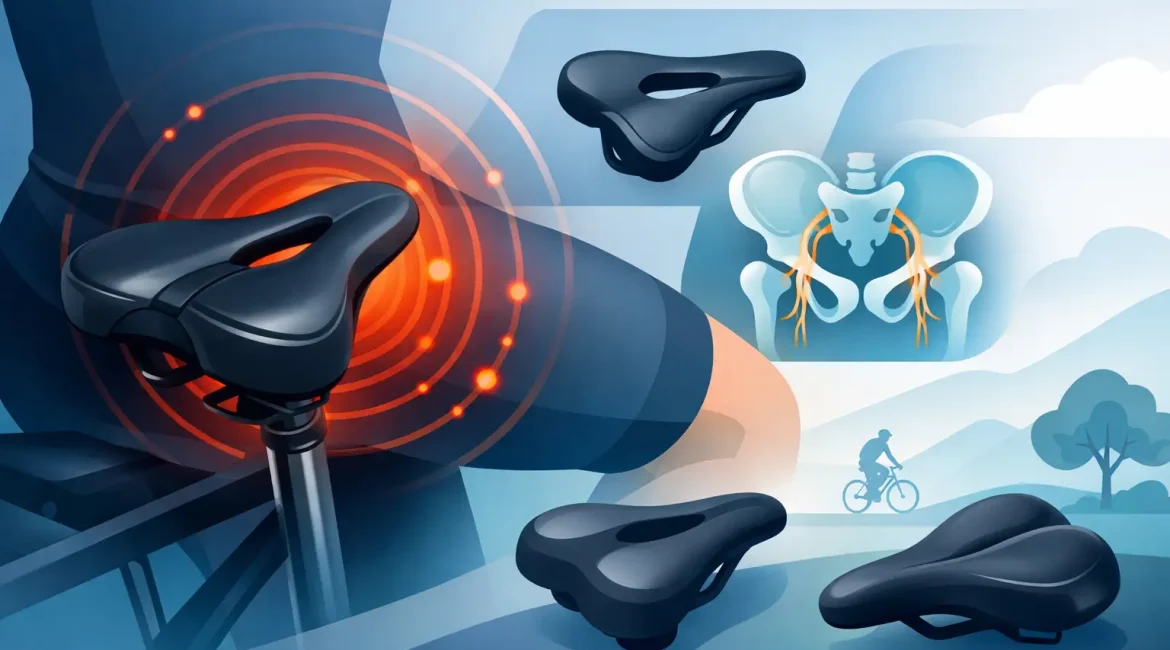
If your hands are fine, your legs feel strong, but your groin goes numb an hour into the ride, the problem is rarely just “more padding”. The best bike seat for numbness is the one that reduces pressure on soft tissue, supports your sit bones properly, and lets you hold power without grinding sensitive anatomy into the saddle.
That matters more than many riders realise. Numbness is not a minor comfort issue to shrug off until the café stop. It is usually a sign that the saddle is loading the perineum instead of the skeletal structures designed to bear weight. For male riders, that can mean unwanted pressure around the prostate and surrounding nerves and blood vessels. For female riders, the same pressure problem can lead to soft-tissue compression, tingling and persistent discomfort. Either way, the body is telling you the contact points are wrong.
What makes the best bike seat for numbness?
A saddle that solves numbness does three jobs at once. First, it shifts load away from the centre line, where nerves and blood flow are most vulnerable. Second, it gives stable support under the sit bones, so you are not balancing on soft tissue. Third, it reduces friction while you pedal, because repeated rubbing and pressure together create a much bigger problem than either on its own.
This is where many standard saddles fail. Traditional narrow-nose designs were built around old assumptions about what a performance saddle should look like. Even when they include a central cut-out, the overall platform often still pushes the rider into the same compromised position. A cut-out can reduce some pressure, but if the nose is too high, the side edges too aggressive, or the sit-bone support too narrow, numbness can remain.
The best bike seat for numbness is therefore not simply the softest saddle on the market. In fact, very soft saddles often make the issue worse on longer rides. Excessive foam allows the pelvis to sink, which increases contact around the very tissues you are trying to protect. You need controlled support, not a sponge.
Why numbness happens on the bike
Most saddle numbness comes from sustained compression of the perineal area. On the bike, especially in a more forward or aggressive riding position, the pelvis rotates and body weight can move away from the rear bony points of support. If the saddle does not match that movement, pressure builds in the wrong place.
Bike fit plays a role, but it is not the whole story. A saddle that is too high can cause rocking. One that tilts upward can drive the nose into soft tissue. Reach that is too long can pull the rider forward. Yet even on a well-fitted bike, a poorly shaped saddle can continue to create numbness because its geometry is fundamentally wrong for anatomical pressure relief.
That is why riders often spend months adjusting seatpost height, stem length and bar position while the real culprit sits directly beneath them. You cannot fully fit around an unsuitable saddle.
The saddle features that actually matter
A pressure-relieving saddle starts with shape, not marketing. The first feature worth paying attention to is a lowered or less intrusive nose. A bulky, elevated nose is one of the most common causes of groin pressure, especially during endurance riding or when riding on the drops. Reducing that front contact area can dramatically cut numbness.
The second feature is separated support zones for the sit bones. This matters because the pelvis is not meant to rest on one flat central platform. Distinct left and right support pads can help transfer weight to skeletal structures while leaving the middle unloaded.
The third is pad angle. Slightly angled support surfaces can improve stability and reduce inward pressure on soft tissue. This tends to feel more natural over distance than a flat saddle that forces the pelvis into a compromised position.
Material also matters, but only after shape. High-rebound foam can absorb road buzz and reduce pressure peaks without collapsing under body weight. That is very different from overstuffed padding, which often creates heat, friction and instability.
Width is equally important. Too narrow and your sit bones miss the support area entirely. Too wide and the saddle can interfere with pedalling mechanics. The right width depends on your anatomy and riding posture, not on what is popular in the peloton.
Why common fixes do not always work
Many riders try a padded saddle first. It sounds logical, but on longer rides more foam often leads to more compression, not less. The body sinks in, the pelvis becomes less stable, and pressure migrates inward.
Padded shorts can help with chafing and surface comfort, but they cannot correct a saddle that loads the wrong tissues. The same goes for chamois cream. Useful in the right context, yes. A cure for numbness, no.
Cut-out saddles sit somewhere in the middle. Some work well, especially when the cut-out is paired with the right width and profile. Others simply remove material from the centre while keeping the same pressure-inducing shape around it. If the edges of the cut-out carry too much load, the rider may swap numbness for hot spots.
Noseless saddles can reduce central pressure significantly, but they are not ideal for every rider or every discipline. Some cyclists struggle with bike control, thigh clearance or stable power transfer. For commuting or upright riding they may be acceptable. For fast road miles and long-distance efforts, many riders need a more balanced anatomical design.
How to choose the best bike seat for numbness
Start with the problem, not the category. If your numbness appears after 30 to 90 minutes, worsens in an aggressive position, or is focused in the groin rather than the sit bones, you are almost certainly dealing with central pressure overload.
In that case, look for a saddle with clear perineal relief, stable sit-bone support and minimal frontal intrusion. Ignore the old myth that enduring discomfort is part of being a serious cyclist. Pain-free rides are not a luxury feature. They are the result of better engineering.
Next, consider your riding posture. A more upright rider may tolerate a wider rear platform. A road cyclist with significant pelvic rotation needs pressure relief that still works when the torso drops. That is where anatomical saddles with split support structures and a low-profile nose tend to outperform traditional designs.
Be honest about what you have already tried. If you have gone through multiple cut-out saddles and still get numbness, the issue may be that the overall saddle architecture remains conventional. You may need a different design philosophy, not just another variation of the same template.
The design approach that changes the outcome
The most effective modern saddles for numbness are built around anatomy rather than tradition. That means supporting the pelvis where it can safely carry load and removing interference where nerves, vessels and sensitive soft tissue need protection.
A good example of this approach is a saddle with a low nose, separated and angled seat pads, and resilient foam tuned for long-distance support. That combination addresses the three main drivers of numbness at once: direct compression, poor weight distribution and friction during the pedal stroke.
For riders concerned about prostate pressure, this matters even more. Persistent compression at the front and centre of a standard saddle is exactly what many men are trying to avoid, especially with age or after periods of pelvic discomfort. Protecting that area while maintaining performance is not an overcorrection. It is basic ergonomic sense.
This is why a purpose-built saddle such as the Aeroelastic AE Saddle stands apart from generic comfort saddles. It is not trying to mask pressure with bulk. It is engineered to remove the cause of pressure in the first place.
Fit still matters after you buy the saddle
Even the right saddle needs correct setup. Start level or with a very slight nose-down angle. Too much downward tilt can make you slide forward and overload your hands, while too much upward tilt brings the pressure straight back.
Height should allow smooth pedalling without hip rocking. If the saddle is too high, friction increases and contact becomes inconsistent. Fore-aft position should let you feel supported on the rear structure of the saddle rather than perched on its front section.
Give your body a few rides to adapt, but do not ignore persistent numbness. Mild awareness during transition is one thing. Recurring tingling or loss of sensation is a sign to stop adjusting around the issue and address it directly.
The right saddle should let you think about cadence, pacing and the road ahead – not about shifting every few minutes to escape pressure. When that happens, you are not just more comfortable. You are more efficient, more consistent and better protected for the miles still to come.
Choose the saddle that respects your anatomy, not the one that asks you to tolerate avoidable pain.
