
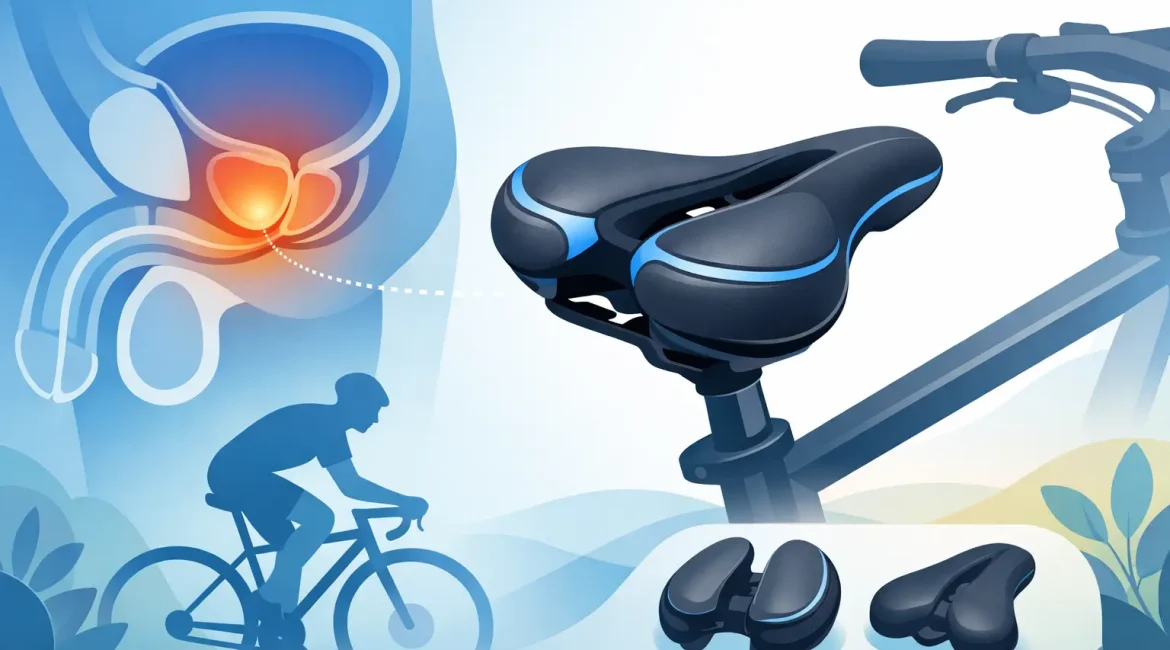
If your ride ends with numbness, burning, or that dull ache deep in the perineum, the best bike seat for prostate comfort is rarely the one that came fitted to the bike. Standard saddles were not built around pelvic health. They were built around convention, and for many riders – especially men doing longer miles – that convention creates pressure exactly where you do not want it.
That matters more than most cyclists realise. Prostate discomfort on the bike is not just about a bit of soreness after a hard weekend. Repeated compression around the perineum can aggravate sensitive tissue, increase numbness, and turn a strong riding position into something you start dreading. If you want pain-free rides, the saddle has to solve the anatomical problem, not just add more padding.
What makes the best bike seat for prostate issues?
The short answer is simple. A prostate-friendly saddle reduces pressure on the centreline, supports your weight on the sit bones, and cuts friction during pedalling. The difficult part is that many saddles claim to do this while still keeping too much structure where the soft tissue sits.
A good saddle for prostate relief does not merely have a token cut-out. It changes how load is distributed. When you are riding in a road position, your pelvis rotates forward. That rotation can push soft tissue into the saddle nose and central channel, especially on narrower or more aggressive designs. If the saddle still carries your weight through the perineum, the marketing does not matter.
The best designs shift support outward and rearward to the bony structures that are meant to bear load. That usually means separated seating zones, a lower nose profile, and dimensions based on actual sit-bone width rather than a generic racing silhouette. Pressure relief has to be engineered, not implied.
Why standard saddles keep causing the same problem
Traditional saddles tend to fail in three ways. First, the nose is often too prominent, which increases contact and rubbing at the front of the saddle. Second, the centre section may include a groove or cut-out, but still leaves enough surrounding material to compress soft tissue under load. Third, many shapes are simply too narrow in the wrong place, so riders roll inward and end up chasing support with the most sensitive part of the body.
More padding is not always the answer. Soft gel can feel pleasant in the garage, then collapse on a long ride and allow deeper pressure into the perineum. Very firm saddles can also be wrong if their shape is poor. This is why riders often bounce between models without solving the issue. They change surface feel, but not pressure mechanics.
That is also why a saddle can feel acceptable for 30 minutes and become a problem after two hours. Localised pressure, heat build-up, and repetitive friction accumulate. What seems manageable on a café spin can become a serious comfort issue on endurance rides, indoor sessions, or consecutive training days.
The features that actually protect your prostate
If you are comparing options, focus less on labels like endurance, comfort, or performance, and more on structure.
A lower saddle nose is one of the most important details. It reduces upward contact into the perineum when your hips rotate forward, especially in a more aerodynamic position. This is not a cosmetic tweak. It changes where the saddle meets the body.
Separated and angled seat pads are another major advantage. Instead of asking soft tissue to bridge a central area, this design supports the rider on the left and right sides where the sit bones and surrounding structures can tolerate load more effectively. Angling the pads also helps reduce inner-thigh rubbing and improves pedalling clearance.
Foam choice matters too. High-rebound polyurethane foam tends to perform better than soft, dead-feeling padding because it cushions without collapsing too quickly under sustained pressure. You want support with controlled give, not a sponge that bottoms out.
Width is equally important. A saddle that matches sit-bone spacing gives the pelvis a stable platform. Too narrow, and pressure migrates inward. Too wide, and you can create chafing or interfere with leg movement. The best bike seat for prostate relief is not just soft or cut away – it is properly proportioned for how your body carries weight on the bike.
Cut-out, noseless, or anatomical split saddle?
This is where trade-offs matter.
A traditional cut-out saddle can help if the surrounding shell and padding genuinely remove central pressure. For some riders, that is enough. For others, the cut-out edges create new hot spots, or the nose remains too high and too intrusive when riding hard.
Noseless saddles can dramatically reduce perineal contact, but they often come with compromises in bike control, stability, and adaptation. Some riders never get on with them, especially on road bikes, climbs, or longer outdoor rides where positional control matters.
Anatomical split saddles sit in a more useful middle ground for many cyclists. They preserve the control and familiarity of a performance saddle while removing pressure from the centreline more decisively than a standard cut-out design. When done properly, this approach can reduce numbness, friction, and prostate irritation without making the bike feel strange underneath you.
That is the reason many experienced riders move away from conventional shapes after years of trying to tough it out. The body usually tells the truth long before the industry catches up.
Best bike seat for prostate comfort on long rides
Long-distance riding exposes every design flaw. A saddle that feels fine for short efforts can become a liability once sweat, fatigue, and sustained pelvic rotation enter the picture.
For endurance cyclists, the best bike seat for prostate comfort is one that remains stable over hours, not minutes. Stability matters because constant micro-adjustments increase friction. If you are shuffling around to escape pressure, your saddle is already failing. The right shape lets you settle into position, rotate the pelvis naturally, and keep power delivery smooth.
This is particularly relevant for middle-aged and older riders, or anyone already dealing with pelvic sensitivity, prostatitis history, or recurring numbness. In those cases, a standard performance saddle is often the wrong starting point. Protecting your prostate is not about giving up speed. It is about removing a mechanical barrier that limits time in the saddle and confidence on the bike.
Fit still matters – but fit cannot fix the wrong saddle
A poor saddle position can worsen prostate pressure. If the nose is tipped too high, if the saddle is too far forward, or if bar drop forces excessive pelvic rotation, discomfort can intensify quickly. Bib shorts, riding posture, and overall bike fit all play a role.
But fit should not be used as an excuse for a saddle that is fundamentally flawed. A proper fit can refine a good saddle. It cannot magically turn a pressure-heavy shape into an anatomical one. Many riders spend months adjusting millimetres when the real problem is sitting under them the whole time.
The smarter approach is to start with a design that removes central pressure by intention, then fine-tune height, tilt, and fore-aft position. Once the saddle is supporting the right structures, bike fit changes become productive rather than desperate.
Who should switch sooner rather than later?
If you regularly finish rides with numbness, tingling, burning, or a sense of deep soreness between the sit bones, do not treat that as normal adaptation. If you avoid longer rides because of saddle discomfort, or if indoor training feels worse than road riding, the saddle deserves immediate scrutiny.
The same applies if you have been told to look after prostate health, if you are returning to cycling after pelvic issues, or if conventional cut-out saddles have only partly solved the problem. You are not looking for more tolerance. You are looking for a different load path.
That is where purpose-built anatomical saddles stand apart. Aeroelastic approaches this with a low nose, separated and angled support zones, and dimensions based on sit-bone research rather than old saddle templates. The goal is direct: Zero Friction, reduced perineal pressure, and pain-free long-distance riding.
There is no miracle seat that suits every pelvis, every riding posture, and every bike. But there is a clear pattern in what works. The best saddle for prostate relief supports bone, protects soft tissue, and stays comfortable when the miles stack up. If your current saddle still asks your perineum to carry the load, it is not a badge of toughness. It is a design problem.
Your body should not have to absorb the cost of outdated saddle shapes. Choose a seat built around anatomy, and the bike becomes what it should be again – fast, efficient, and comfortable enough to keep riding tomorrow.
